ABOUT FUNDAPARTNER.
MEET THE PAN-AFRICAN FINANCIAL ENGINE.
Our Values
Integrity
Transparency and ethical practice sit at the core of everything we do. We build trust by maintaining the highest standards of financial governance.
Execution
We maintain a relentless commitment to transaction success. We don't just advise; we drive deals across the finish line with rigorous follow-through.
Innovation
We reject cookie-cutter models. Our team delivers custom-tailored financial engineering designed to solve complex funding challenges in dynamic markets.
Partnership
We focus on building long-term value through deep collaboration. We align our success completely with the sustainable growth of our clients and regions.
Our Leadership Team
MEET THE TEAM AND MISSION BEHIND AFRICA'S GROWTH
Our Mission
To engineer robust, sustainable financial solutions that unlock capital for transformative African projects, driving long-term economic growth and expanding local opportunity.
Our Vision
To be the premier Pan-African financial engine, recognised globally for unparalleled market expertise, innovative deal structuring, and enduring client partnerships.


Headquartered in Accra, Ghana, Fundapartner sits at the heart of one of Africa’s fastest-growing financial ecosystems. We combine local market fluency and regulatory insight with global financial standards. This strategic positioning offers our global investment partners a unique, boots-on-the-ground perspective and seamless connectivity across sub-Saharan Africa.
Our Leadership Team
READY TO SECURE THE FUTURE OF YOUR PROJECT?
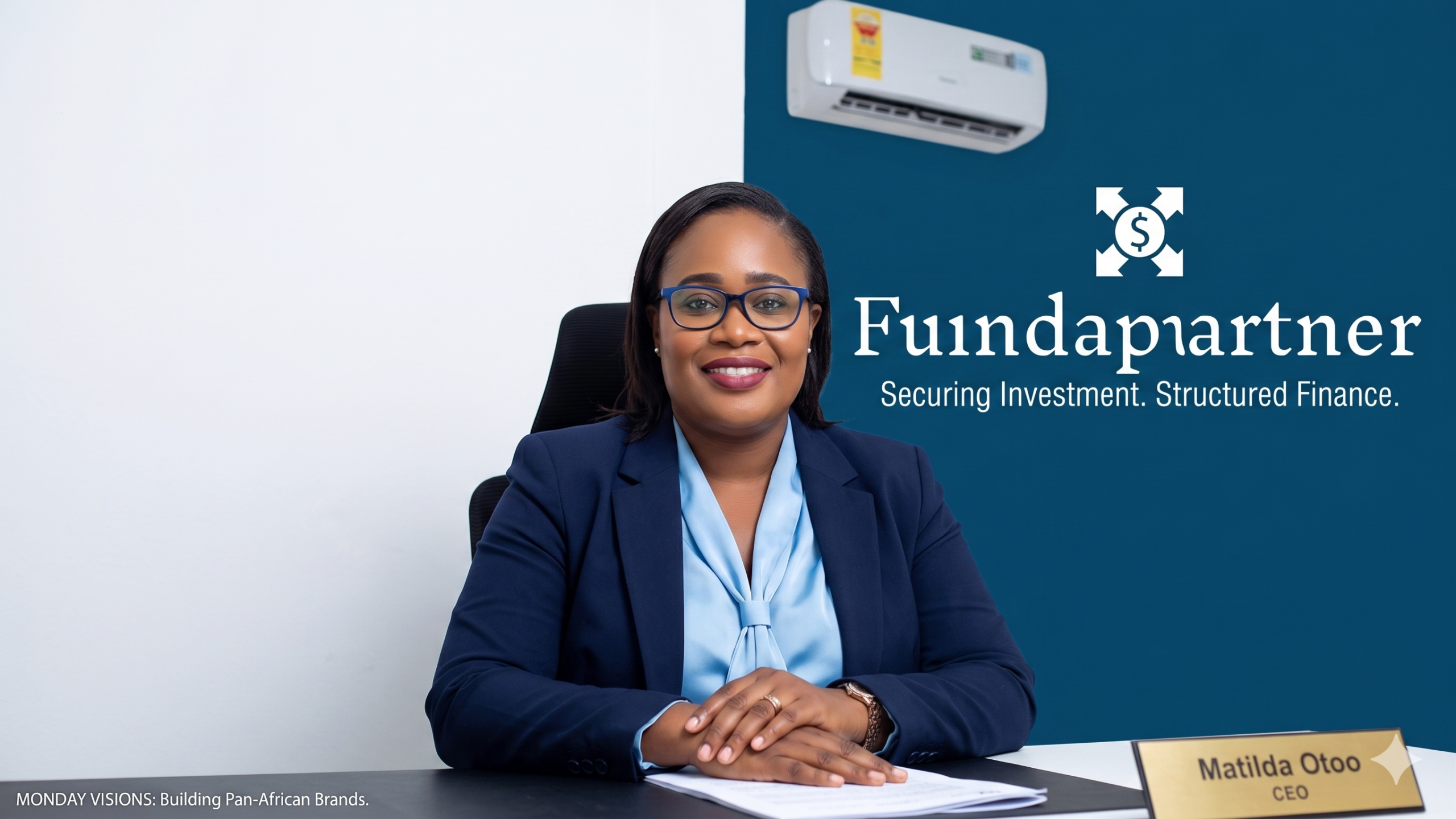
Matilda Otoo CA — Chief Executive Officer
Matilda Otoo is a chartered accountant and chartered tax professional who has spent nearly twenty years on the numbers side of African business — first auditing companies, then running their finance functions, and now raising capital for them.
She began at ProCredit Savings and Loans — the SME lender later acquired by Fidelity Bank Ghana, which bought it precisely for the strength of its SME credit process. Trained as a credit specialist under IPC Holding, she analysed borrowers and presented them to a credit committee. It is the experience most intermediaries lack: she has sat on the lender’s side of the table and knows what a credit paper has to answer before anyone will fund it.
At KPMG in Accra she rose from audit associate to senior associate within two years, preparing IFRS-compliant financial statements and leading audit work including USAID-funded programmes. She then moved into industry — finance manager at a Tema shipping line, then Senior Manager, Finance and Procurement at Ringier Ghana, the Swiss multinational’s digital publishing and e-commerce business, where she rebuilt inventory, procurement, treasury and payroll controls, cut procurement costs by up to 30 per cent, and was recognised as the group’s strongest finance lead in Africa for ERP migration.
In 2018 she founded Premier Group, running accounting and tax advisory alongside a land agency. She has since served as Assistant Director in the Health Division of the Ghana Audit Service, and as Finance Manager and Deputy Managing Director of a cocoa processing business in Accra.
That range is deliberate. Audit, shipping, digital, agri-processing, insurance and lending each price risk differently, and knowing how a funder in one sector reads a set of accounts is what makes a transaction in another sector closeable.
She holds an MBA from Kwame Nkrumah University of Science and Technology, read accounting, taxation and management at the University of Cape Coast, and is a member of the Institute of Chartered Accountants Ghana and the Chartered Institute of Taxation Ghana.
Her working view is that most businesses turned down for funding are not unfundable — they are unstructured. A commercial bank represents one risk appetite, one tenor and one security requirement; a rejection from it is not the market speaking. The work is matching a business to the instrument that fits the shape of its cash flow, whether that is a letter of credit, receivables discounting, growth equity, or a blended structure where a development institution absorbs risk a commercial lender will not.
She writes regularly on African capital markets, trade finance and deal structuring to an audience of more than 16,000 followers.